← back to the catalogue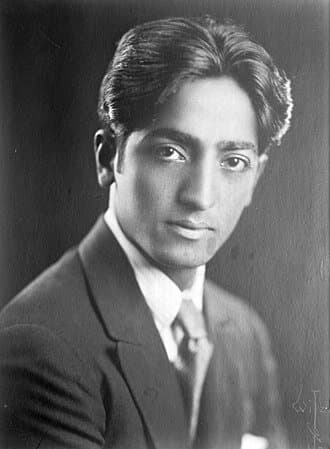
› reshelve this entry
See something off? The librarian reads these on Sundays. Wrong cover, wrong details, a duplicate of another entry — let us know and we’ll sort it.
Author file · 09967
Jiddu Krishnamurti
1895–1986
On Jiddu Krishnamurti
A brief life
Jiddu Krishnamurti was born in 1895 in Madanapalle, British India, the eighth of eleven children in a Telugu-speaking Brahmin family. Discovered as a boy by the Theosophical Society and groomed as a World Teacher, he dissolved the order built around him in 1929, spending the next six decades travelling the globe as an independent speaker. He died in Ojai, California, in 1986.
On the page
Krishnamurti produced no systematic philosophy but rather over sixty books of transcribed talks, dialogues, and essays, including The First and Last Freedom, Freedom from the Known, and The Awakening of Intelligence. His subject was the nature of human consciousness, the mechanism of thought, and the possibility of a radical, choiceless awareness that he called "observation without the observer."
In their time
Krishnamurti attracted a devoted international following from the 1930s onward, speaking to packed halls in India, Europe, and North America, yet he consistently refused the role of guru. Aldous Huxley, David Bohm, and Joseph Campbell engaged seriously with his ideas, while mainstream academia largely ignored him; his work found its readership among spiritual seekers and countercultural intellectuals rather than institutional critics.
The afterlife
Krishnamurti's talks continue to be published and studied, with foundations in India, England, and the United States preserving his recorded words. His insistence on self-inquiry without authority has influenced figures as varied as Eckhart Tolle, Bruce Lee, and the physicist David Bohm, and his books remain in steady print as perennial staples of the contemplative section.
Works in the catalogue · 2 entered
On the shelves
In conversation with