no plate
For Lizzie and Harriet
raretomes
Books from independent sellers worldwide
See something off? The librarian reads these on Sundays. Wrong cover, wrong details, a duplicate of another entry — let us know and we’ll sort it.
Author file · 10447
On Robert Lowell
A brief life
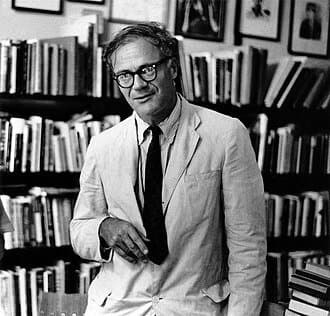
Robert Lowell was born in 1917 into the prominent Boston Brahmin family, a lineage he spent his life both anchoring himself to and rebelling against. His education at Kenyon College under John Crowe Ransom and his subsequent conversion to Catholicism shaped his early intellectual rigor. He suffered from severe, recurring manic-depressive illness throughout his adulthood, which frequently necessitated hospitalizations and became a central subject of his poetry.
On the page
Lowell’s career began with the formalist, dense, and historical intensity of 'Lord Weary's Castle' and 'The Mills of the Kavanaughs'. He later pivoted to the raw, confessional style of 'Life Studies', which dismantled his earlier aesthetic in favor of direct, autobiographical transparency. His final works, including 'The Dolphin', continued to blur the lines between private correspondence and public art, often incorporating actual letters from his life.
In their time
Lowell was recognized almost immediately as the preeminent poet of his generation, winning the Pulitzer Prize for 'Lord Weary's Castle' in 1947. His transition to confessional poetry in 'Life Studies' caused a seismic shift in American letters, drawing both immense praise for its courage and criticism for its perceived exploitation of his family's private traumas. He remained a central, if controversial, figure in the literary establishment until his death in 1977.
The afterlife
Lowell is credited with inventing the confessional mode, a movement that defined the trajectory of American poetry for decades. His influence is visible in the work of Sylvia Plath, Anne Sexton, and the subsequent generations of poets who utilize the self as a primary site of inquiry. He remains a canonical figure whose work serves as a bridge between the high modernism of T.S. Eliot and the intimate, unfiltered lyricism of the late twentieth century.
Works in the catalogue · 2 entered

1 copy on offer
Preoccupied with
In conversation with